


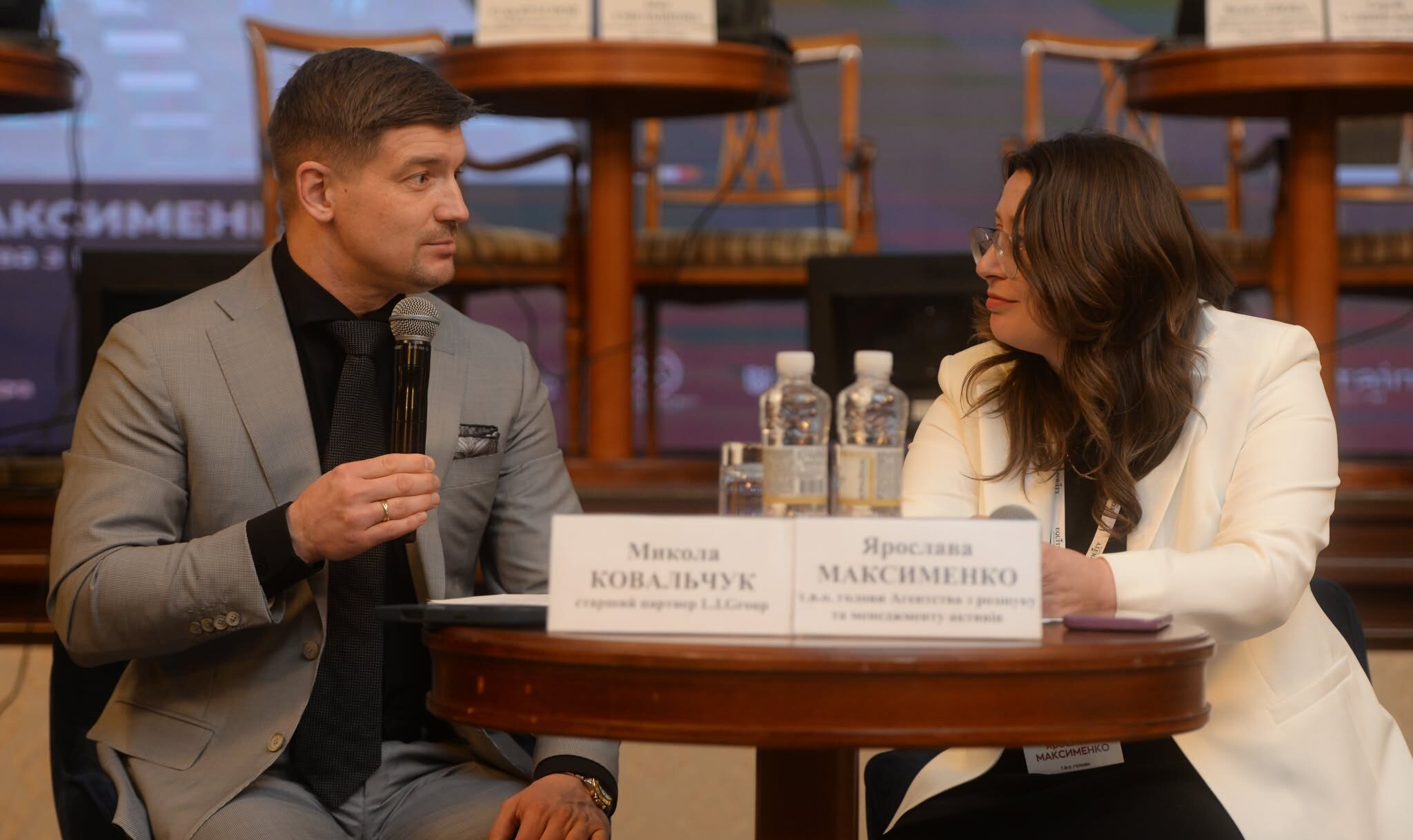
Within the framework of the 14th International Judicial and Legal Forum, Mykola Kovalchuk, Senior Partner at L.I.Group, conducted an open interview with Yaroslava Maksymenko, Acting Head of ARMA – the Asset Recovery and Management Agency.
During the discussion, the participants addressed the outcomes of the 2025 ARMA reform, practical aspects of managing seized assets under martial law, new approaches to transferring assets into management, and the prospects for the development of judicial practice in this area.
From Reform to Practical Implementation
One of the key topics of the interview was the first results of the legislative changes introduced in 2025. According to Yaroslava Maksymenko, the reform provided the Agency with additional tools for the systematic registration of assets, assessment of their condition, and determination of the most effective management mechanisms.
Among the important innovations is the classification of assets into simple and complex categories, allowing different management approaches to be applied depending on the nature of a particular asset. This mechanism is intended to ensure more effective asset management and the preservation of economic value.
At the same time, the participants noted that a comprehensive assessment of the reform’s effectiveness requires time. The practical application of the new regulations is still evolving, and meaningful conclusions will only be possible after sufficient implementation experience has been accumulated.
 Asset Management During Wartime
Special attention was devoted to the management of seized assets under wartime conditions.
Mykola Kovalchuk emphasized that the state’s task today is not only to preserve seized property but also to maintain its economic efficiency. This is particularly relevant for large enterprises, corporate rights, and complex business structures, the management of which directly affects the country’s economic stability.
The discussion also covered the challenges associated with transferring such assets into management, preserving their market value, and ensuring business continuity in cases involving operating enterprises.
Transparency of Procedures and Business Confidence
One of the central issues discussed was the transparency of ARMA’s operations and the level of business confidence in the mechanisms for managing seized assets.
The participants highlighted the importance of open and competitive selection procedures that allow professional asset managers to be engaged while minimizing the risks of non-transparent decision-making.
Particular attention was also paid to the need for effective oversight of asset managers and maintaining a balance between the interests of the state, asset owners, and the business community.
Judicial Oversight and the Development of New Case Law
A significant part of the interview focused on the role of judicial oversight in the field of seized asset management.
The participants noted that judicial practice will become one of the key factors determining the effectiveness of the newly introduced legislative mechanisms. An important task remains the development of consistent approaches to disputes related to asset transfers, the activities of asset managers, and the protection of the rights of all parties involved.
Special attention was given to the future development of legal practice concerning corporate rights, complex property complexes, digital assets, and other categories of property requiring a specialized approach.
 Further Development of the Asset Management System
Summarizing the discussion, Mykola Kovalchuk and Yaroslava Maksymenko emphasized the importance of further improving the mechanisms for asset tracing, preserving market value, managing seized assets, and their subsequent realization.
The open interview demonstrated that ARMA currently faces not only the task of implementing legislative changes but also practical challenges related to their effective application. Therefore, the further development of the asset management system requires continuous professional dialogue between the state, business, and the legal community.
L.I.Group extends its gratitude to Yaroslava Maksymenko for the open and substantive discussion, and to the organizers of the 14th International Judicial and Legal Forum for providing a professional platform for discussing current challenges and future prospects for the development of Ukraine’s legal system.