


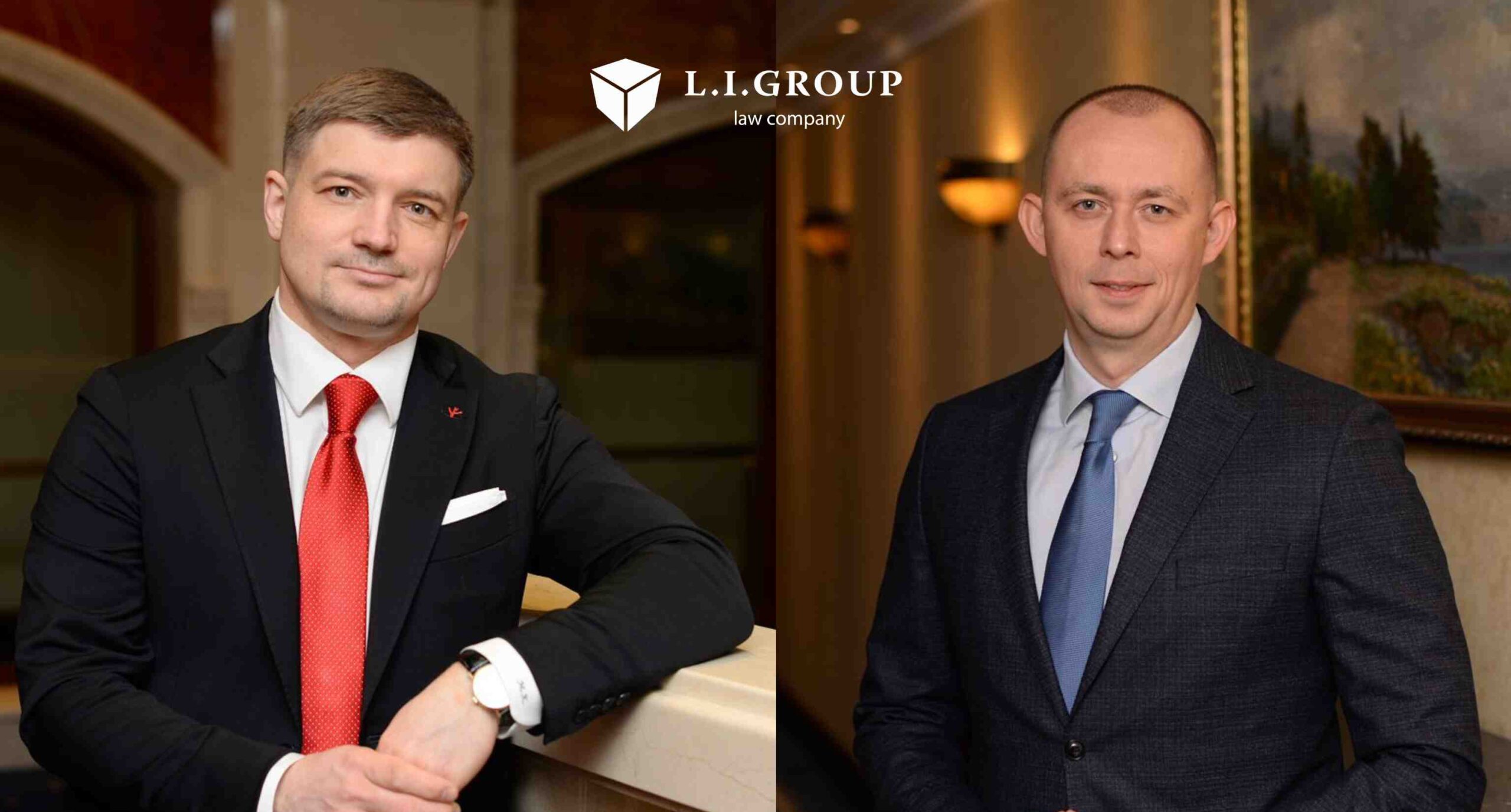
Senior Partners of L.I.Group, Mykola Kovalchuk and Artur Megeria, in an interview with Yurydychna Hazeta, spoke about the realities of the bankruptcy market during wartime, the role of restructuring in preserving businesses, corporate conflicts, NPLs, management liability, and the key challenges facing insolvency trustees.
— L.I.Group has traditionally been perceived as one of the key teams in the field of bankruptcy on the Ukrainian legal market, but at the same time, over the past few years, you have significantly expanded your litigation practice. If we assess the team’s current workload, which practice areas generate the main volume of work today?
M.K.: In fact, since the foundation of our company in 2008, the core practices have been bankruptcy and multi-jurisdictional litigation.
A.M.: I agree. The main volume of work remains focused on these two key areas; however, both the number of cases and the scope of work have increased significantly. In addition, bankruptcy practice is universal in nature, as bankruptcy proceedings combine the resolution of various types of disputes, including contractual, corporate, labor, asset recovery claims, criminal proceedings, intellectual property disputes, and more. Therefore, the firm specializes in a wide range of practice areas even within bankruptcy procedures alone and continuously monitors legislative changes and current Supreme Court positions.
M.K.: Exactly. In addition, we handle a large number of court cases that constitute separate proceedings unrelated to bankruptcy.
— The insolvency market in Ukraine has undergone substantial transformation in recent years. Which categories of cases currently form the basis of your practice?
M.K.: I would not say that the insolvency market itself has changed dramatically. What changed first and foremost were the working conditions. Proceedings involving enterprises located in temporarily occupied territories or active combat zones are being closed, while many companies undergoing bankruptcy procedures have been forced to relocate.
This has complicated the work of insolvency trustees, particularly in terms of inventory procedures and asset tracing. There are frequent situations where debtors attempt to conceal assets by claiming they were destroyed or remain located in occupied territories.
A.M.: Enterprises located near the frontline remain a separate challenge: access to such facilities is restricted, property may suffer significant damage due to shelling and bombing, and in some cases assets are used by units of the Armed Forces of Ukraine for defense purposes.
— How are strategic decisions regarding the development of practice areas made within the firm? Is there a clear division of key areas and responsibilities among the senior partners?
A.M.: Strategic decisions are always made jointly by the senior partners after prior discussion and coordination with junior partners responsible for a particular project or client. Responsibilities are divided based on client relationships and communication rather than by practice areas.
— Today, large corporate conflicts almost always combine bankruptcy procedures, litigation, and criminal law components. How is the team’s work on such complex projects organized at L.I.Group?
M.K.: A significant number of bankruptcy procedures are, in fact, the result of corporate conflicts. In such matters, in addition to insolvency proceedings themselves, numerous court disputes arise, and sometimes parallel criminal proceedings develop as well.
At L.I.Group, work is organized based on specialization. The bankruptcy practice is handled by attorneys specializing in insolvency matters, many of whom also have experience as insolvency trustees. Litigation is handled by attorneys specializing in dispute resolution, with different lawyers managing disputes in the legal areas and jurisdictions where they possess the strongest expertise and experience.
A.M.: Teams are formed for each specific project so that every direction is covered by its own group of specialists, ensuring coordinated, efficient, timely, and, when necessary, creative cooperation. Creativity and unconventional thinking are key elements of our firm’s work. I truly like the phrase “Think out of the box” — it is the credo of our company, meaning unconventional thinking in solving tasks and the absence of the concept of a “hopeless situation.”
— In the field of distressed assets, the stakes are traditionally high. Where is the ethical line for you as partners that you are not prepared to cross, even for a highly profitable case?
A.M.: Ethical boundaries have always existed, continue to exist, and always will exist for us because they are the foundation of our long-standing positive reputation on the market. For example, we will never cross the line when a client attempts to seize someone else’s property or deliberately cause harm to the state or state-owned enterprises. Such matters are definitely not for us, regardless of the financial benefits offered.
M.K.: Since approximately 2010, our company has closely cooperated with banking institutions, and in nearly 95% of cases we represent clients on the banks’ side. There are, of course, cases where we represent debtors while banks act as creditors, but in such projects our clients clearly understand that we will never cross “red lines” and always seek communication with banks for amicable settlement. Most often we defend clients and far less frequently attack. Although, as they say, the best defense is offense. This applies to martial arts, warfare, and legal practice is no exception. Therefore, if appropriate and carried out within the law and the rules of legal ethics, such actions may also be used to achieve a positive outcome when a client acts aggressively and irrationally.
At the same time, ethics are extremely important to us because reputation is the foundation of any law firm and every attorney individually. Reputation is above all. Money can always be earned, but once reputation is lost, restoring it is extraordinarily difficult and sometimes impossible. That is why the ethical code is not an empty phrase for us.
— You are actively involved in the professional self-governance of insolvency trustees. To what extent does this institution genuinely influence professional standards today? Is a new culture of the insolvency market emerging?
A.M.: Self-governance genuinely influences the profession. After all, who understands better than insolvency trustees themselves where legislation does not function properly? We work inside bankruptcy procedures every day and clearly see existing gaps and what changes are necessary.
At the same time, the restructuring and bankruptcy market is actually quite small. Most professionals know each other and regularly encounter one another in cases. Therefore, the professional community reacts very quickly: if someone behaves unethically, it becomes known almost immediately. In this sense, market culture is shaped not only by legislation but also by the professional community itself. However, the Code of Ethics for insolvency trustees must definitely be formally approved at the regulatory level, if that is what you mean, and this is exactly what we are striving for and intend to achieve.
M.K.: I would separately note that Artur is extremely actively involved in professional self-governance within our team. Sometimes it seems he devotes as much time to it as to the legal business itself. Thanks to such efforts, the Kyiv Council today is probably one of the most proactive and productive in Ukraine, while the Kyiv Regional Council consistently supports the city of Kyiv — not because we are partners in the same firm, but because strength lies in unity. Achieving positive changes in the bankruptcy sphere, improving working conditions, and protecting the rights of insolvency trustees are goals that should unite the regions. Unfortunately, at times this resembles a struggle for power that harms everyone involved. We must correct this and act in coordination. Only then will we achieve positive changes for the profession and community rather than engage in destructive conflicts. The lessons of history, especially the history of Ukraine, should have taught us long ago to work toward results instead of vanity and personal ambition.
— Looking at the structure of your cases, how would you describe the financial condition of Ukrainian business today?
M.K.: In short, business is undoubtedly facing difficulties because we are operating under wartime conditions. Unfortunately, some enterprises have ceased to exist, while their owners have left Ukraine. However, the overwhelming majority have demonstrated resilience, flexibility, and an extraordinary ability not only to survive but also to develop. Some entrepreneurs relocated their businesses, others changed their business profile, and certain sectors, especially in western Ukraine, are generating significant profits. It is encouraging that nearly all of them continue earning and reinvesting in Ukraine, supporting the Armed Forces of Ukraine, paying taxes, and therefore believing in victory.
— Under current realities, does restructuring function as a genuine business rescue tool, or does it mostly remain a delayed liquidation process?
A.M.: Procedures aimed at restoring solvency are necessary and important for businesses, especially under martial law.
Our company has experience implementing pre-trial restructuring procedures for one of Ukraine’s largest metallurgical enterprises — PJSC “DMZ” — and one of the country’s largest manufacturers of machinery and equipment for agriculture and forestry — JSC “KhTZ”.
Following the beginning of the full-scale invasion, these companies required additional time to adapt to the new realities, and pre-trial restructuring allowed them to preserve business operations, retain jobs, and avoid bankruptcy and subsequent liquidation.
We also have positive examples of court-supervised restructuring procedures, particularly in the case of LLC “Lviv Bus Plants” (LAZ), where debts to all creditors were repaid, including wage arrears and outstanding obligations to a state-owned bank. This is something we are genuinely proud of.
Currently, our company is also developing expertise in the new preventive restructuring procedure, and as of today we already have two successful cases with approved restructuring plans totaling more than UAH 2 billion involving creditors for PJSC “DMZ” and JSC “KhTZ”.
To summarize, restructuring is unquestionably a real and effective tool for avoiding bankruptcy when approached professionally and thoughtfully, with balanced solutions that consider the interests of both debtors and creditors.
M.K.: I would add that restructuring, whether pre-trial or court-supervised, is the primary objective within bankruptcy law itself — namely restoring the debtor’s solvency while satisfying creditors’ interests. Destroying is easy; preserving and restoring is a sign of true mastery.
— Courts are increasingly moving toward recovering debts from the personal assets of management and owners. For the insolvency market, is this a long-awaited strengthening of creditor protection or a new pressure tool against businesses?
M.K.: The institutions of joint and subsidiary liability of management and beneficial owners are necessary tools in cases where their actions or inaction directly caused the company’s bankruptcy. If this is proven in court through proper evidence, recovering debts from the personal assets of managers or owners is a logical mechanism for protecting creditors. In such situations, liability should be borne not only by the company itself but also by those who made the decisions. Therefore, I would not describe this as a pressure mechanism against business. It is about responsibility for decisions and actions that led to insolvency.
A.M.: I completely agree with Mykola. The mechanism of joint and subsidiary liability is intended to create an additional source for debt repayment to creditors, so the very concept undeniably strengthens creditor protection.
However, in practice this mechanism can only be effective if business owners actually possess assets, which unfortunately is not always the case. In addition, the procedure is lengthy because it first requires the sale of the debtor’s property before moving to the liability stage concerning business owners. At the same time, maintaining a balance between creditors’ interests and the principle of good-faith business activity is critically important.
In my view, this mechanism serves as an element of balance between creditor protection and fair business conduct. Nevertheless, it still requires further practical improvement to facilitate its application.
— Distressed debt is often called an indicator of the economy. How attractive is the NPL market to new capital today, and are banks willing to compromise with debtors instead of engaging in years of litigation?
M.K.: If we speak about the NPL market in the form in which it existed five years ago, when a number of large financial companies were created to purchase entire pools of debt on a massive and systematic basis with the goal of recovering obligations and generating extremely high margins, then today the condition of this market can be described as rather weak in comparison. The business of acquiring distressed obligations has become significantly less attractive and more risky due to martial law, unpredictable wartime risks, and sanctions imposed by the state on many NPL market participants.
A.M.: I agree. As for compromises with debtors, banks and other creditors generally approach settlement proposals rationally. If an offer is genuinely beneficial for both parties — considering litigation costs, human resources, risks, and the duration of proceedings — creditors may decide that an amicable settlement is appropriate. Of course, there are situations where the parties simply see no possibility for compromise for various reasons.
In reality, every case is unique. Everything depends on the creditor’s management and on the solutions proposed by the debtor.
— In your practice, what more often puts an end to a prolonged conflict: a strong legal position or a timely economic compromise?
A.M.: In our practice, a strong legal position is precisely the catalyst that accelerates the achievement of an economic compromise. That is why it is so important to first build a clear strategy that defines the acceptable boundaries of compromise. A strong legal position creates the proper balance of power because it does not exclude settlements — on the contrary, it makes them realistic and timely.
M.K.: In any dispute or conflict, it is a thoroughly substantiated and professionally prepared legal position that creates the foundation for a fair economic compromise beneficial to the client. Donald Trump’s controversial phrase about the necessity of “having cards” is actually quite appropriate here.
— Considering current market dynamics, which practice areas will L.I.Group focus on most heavily through the end of the year?
M.K.: Given the current realities and the war in our country, market dynamics remain surprisingly stable. Therefore, we will continue focusing on the areas that have traditionally formed the core of our work. Bankruptcy and restructuring, as well as litigation, are the fields where we possess the strongest expertise and experience, and these are the practices where we plan to further strengthen our positions.
At the same time, we remain open to new directions and continue monitoring most legal practices while expanding our expertise in criminal proceedings, tax disputes, sports law, intellectual property, competition law, and other areas. We are interested in constantly broadening the range of our services, while continuing to reinforce the niches we have already established. There is still plenty of time until the end of the year, and the economic situation may change. If the market begins moving in another direction and there is growing demand for investment attraction and investment protection, for example, we will be fully prepared for it.
— Artur, as the Head of the Council of Insolvency Trustees of Kyiv, you see the profession from the inside. How has public perception of the profession changed in recent years? What is the main myth about insolvency trustees that should finally be destroyed?
A.M.: As mentioned earlier, I have the honor of leading the largest and most active regional council, which includes 285 insolvency trustees. Self-governance is important because it forms an active position aimed at improving our profession and eliminating existing gaps within it.
For example, the professional community still faces many unresolved issues requiring improvement, including increasing remuneration levels, protecting insolvency trustees from interference in their professional activities, establishing clear reporting deadlines, and many others. That is why our Council, together with colleagues, prepared two draft laws.
In particular, we developed a draft law aimed at increasing insolvency trustees’ remuneration and guaranteeing payment, and we have already submitted a legislative initiative establishing real legal protection mechanisms for insolvency trustees in their professional activities.
We also maintain constant communication with the Ministry of Justice of Ukraine, courts, and other state authorities.
Therefore, professional self-governance today is a genuine instrument of change for insolvency trustees, and the Council of Insolvency Trustees of Kyiv is actively working in this direction. This work inspires me — it is an interesting and valuable area for the professional community.
— If we analyze disciplinary practice, do you see a balance between necessary state oversight and the risk of pressure on principled and inconvenient insolvency trustees?
A.M.: As of today, oversight of insolvency trustees is carried out by commercial courts and the Ministry of Justice of Ukraine. This approach is rather complicated for the professional community because, in practice, inspections initiated by creditor complaints may be conducted simultaneously by two separate authorities.
In my opinion, it would be appropriate to divide oversight responsibilities between the Ministry of Justice and the courts. For example, courts could supervise the exercise of insolvency trustees’ powers within specific bankruptcy cases, while the Ministry of Justice could oversee compliance with professional requirements, record-keeping obligations, and related matters.
Such an approach would ensure a clear balance of authority between supervisory bodies, avoid duplication of inspections, and reduce excessive administrative pressure on insolvency trustees.
— How do you manage to combine leadership within the professional community with the development of the firm? Does this public role influence strategic decisions within the company?
A.M.: Serving as the Head of the Council of Insolvency Trustees of Kyiv undoubtedly requires considerable time and involvement. At the same time, this role provides a unique opportunity to view the profession systemically — to understand the real challenges faced by the professional community on a daily basis, keep a close eye on ongoing changes, and work toward eliminating existing gaps both in practice and at the legislative level. For me, these are not two parallel directions, but complementary processes.
Public activity allows us to better understand market trends, the positions of courts, regulators, and creditors, which in turn helps shape more balanced strategic decisions within the firm.
— You actively work with international cases and foreign clients. How understandable and acceptable are Ukrainian bankruptcy procedures for international investors today?
M.K.: Working with international cases and foreign clients, we can state that Ukrainian bankruptcy legislation is gradually moving closer to international standards applied in most developed countries. The integration and implementation of international practices in Ukraine are also supported by organizations such as Pravo Justice and IDLO. Therefore, I believe that, with the assistance of qualified Ukrainian lawyers, these procedures are generally understandable and acceptable to foreign investors.
The issue lies not so much in the content of the procedures themselves, but rather in how they are applied in practice. For international investors, the key factor is always fair and impartial justice. This is exactly the area where Ukraine still has significant work to do.
— How realistic is it today to locate and recover assets transferred by debtors into foreign jurisdictions, complex trusts, and offshore structures?
M.K.: Locating and recovering assets transferred to foreign jurisdictions is a complex multi-jurisdictional process that often requires the involvement of foreign legal counsel.
Due to the lengthy duration of litigation in Europe, the United States, and other developed countries, as well as the high cost of such proceedings, далеко not all creditors are willing to initiate and pursue these actions. At the same time, there are successful examples of cooperation between Ukrainian and international legal teams. Although this practice is not yet widespread, it is gradually developing and will likely intensify as Ukraine continues integrating into the European Union.
— You head the Council of Insolvency Trustees of Kyiv Region. Compared with other regions, what are currently the main specifics and challenges of bankruptcy procedures in Kyiv Region?
M.K.: The fact that an insolvency trustee belongs to a particular region does not mean that cases are limited to that territory, as we work throughout Ukraine.
If we speak specifically about Kyiv Region, the events of the first months of the full-scale invasion significantly affected insolvency and bankruptcy proceedings there. Many enterprises suffered substantial and sometimes irreparable losses of assets during the occupation, and for some of them bankruptcy became a forced step.
At the same time, there is another trend — due to business relocation and the large influx of internally displaced persons from frontline regions, many new enterprises have appeared in the area, accompanied by a significant inflow of financial resources. Therefore, despite difficult circumstances, I assess the overall business development dynamics in the region as positive.
Overall, I am convinced that after the war ends and after our victory, the economy will develop extremely rapidly because Ukraine is destined to become one of the world’s leaders and a leader in Europe. These are not merely patriotic or emotional words — this is a statement of fact.